

In the ever-evolving landscape of cybersecurity, the methods we use to identify and mitigate vulnerabilities are constantly changing. The world of penetration testing, or pentesting, is no exception. We've witnessed a significant transformation from manual, rule-based scanning to the dawn of intelligent, autonomous systems. This evolution can be broadly categorized into three distinct generations, each with its own strengths and limitations, culminating in the advanced capabilities of platforms like Scantist PAIStrike.
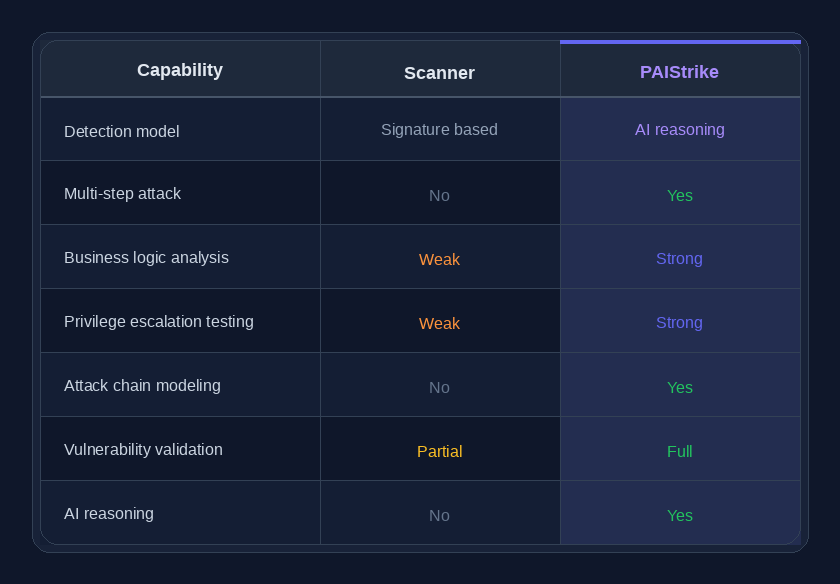
The first generation is defined by traditional vulnerability scanners such as Acunetix, Burp Suite Scanner, and Nessus. These tools brought automation to the forefront, capable of scanning systems with incredible speed. They operate on rule-based detection engines, relying on vast signature libraries to identify known vulnerabilities through methods like payload fuzzing.
However, their speed comes at a cost. Traditional scanners are notorious for a high rate of false positives and a significant weakness in testing complex business logic. Their fundamental limitation is the inability to construct or understand an attack chain—the series of steps a real attacker would take. They identify isolated potential weaknesses, but they can't tell you if those weaknesses are truly exploitable or how they might be combined to create a significant breach.
The second generation, represented by platforms like Pentera and Horizon3's NodeZero, marked a step forward. These tools moved beyond simple scanning to automate more complex penetration testing workflows. They often focus on validating defensive controls and simulating attacks on internal networks, such as identifying privilege escalation paths within Active Directory.
While a significant improvement, these platforms still largely rely on predefined attack techniques and playbooks. They represent a more sophisticated form of automation but lack the deep, adaptive reasoning required to mimic the creativity and intuition of a human attacker or a truly intelligent AI.
We are now entering the third generation, led by pioneering platforms like Scantist PAIStrike. This new wave of technology is built not on static rules, but on AI-driven reasoning and multi-agent orchestration. Instead of just asking, "Where are the vulnerabilities?", these systems answer the critical question: "How would a real attacker compromise this system from end to end?"
•AI-Driven Reasoning: It evaluates application behavior in real-time and dynamically adapts its attack strategies, much like a human expert.
•Multi-Agent Architecture: Coordinated AI agents, each specializing in a different phase of an attack (reconnaissance, strategy, execution, validation), work together to simulate a comprehensive red-team campaign.
•Attack Chain Modeling: It moves beyond isolated vulnerabilities to construct and validate realistic, multi-step attack paths—for example, chaining an SQL injection to an authentication bypass, then to privilege escalation, and finally to sensitive data extraction.
•Automatic Validation: To eliminate the noise of false positives, every potential vulnerability is verified through actual exploit execution.
This evolution from static scanning to autonomous red teaming represents a fundamental paradigm shift in offensive security. As applications become more complex and the shortage of skilled security professionals grows, AI-driven platforms like PAIStrike are becoming essential for providing the continuous, deep, and realistic security validation that modern enterprises demand.